Digital Business Card vs. Paper Card: What Each One Wins
An honest comparison between digital and paper business cards: what wins in cost, traceability, data capture and capacity, and in what contexts paper still makes sense — the answer is almost always to use both.
July 13, 2026
7 min read
2 views

AI Summary
An honest comparison between digital and paper business cards: what wins in cost, traceability, data capture and capacity, and in what contexts paper still makes sense — the answer is almost always to use both.
A digital card costs less as soon as you make a single change and leaves a trace of every contact; a paper card only wins when nobody's going to pull out their phone or the gesture of handing it over matters as much as the data it carries. It's not a matter of fashion: they're different tools that solve different parts of the same problem, and the honest answer is almost always to use both at the same time.
Here are the five axes where the difference really shows — not the idea that "paper is dead," which is as weak as the opposite argument.
Cost isn't what you pay the first time
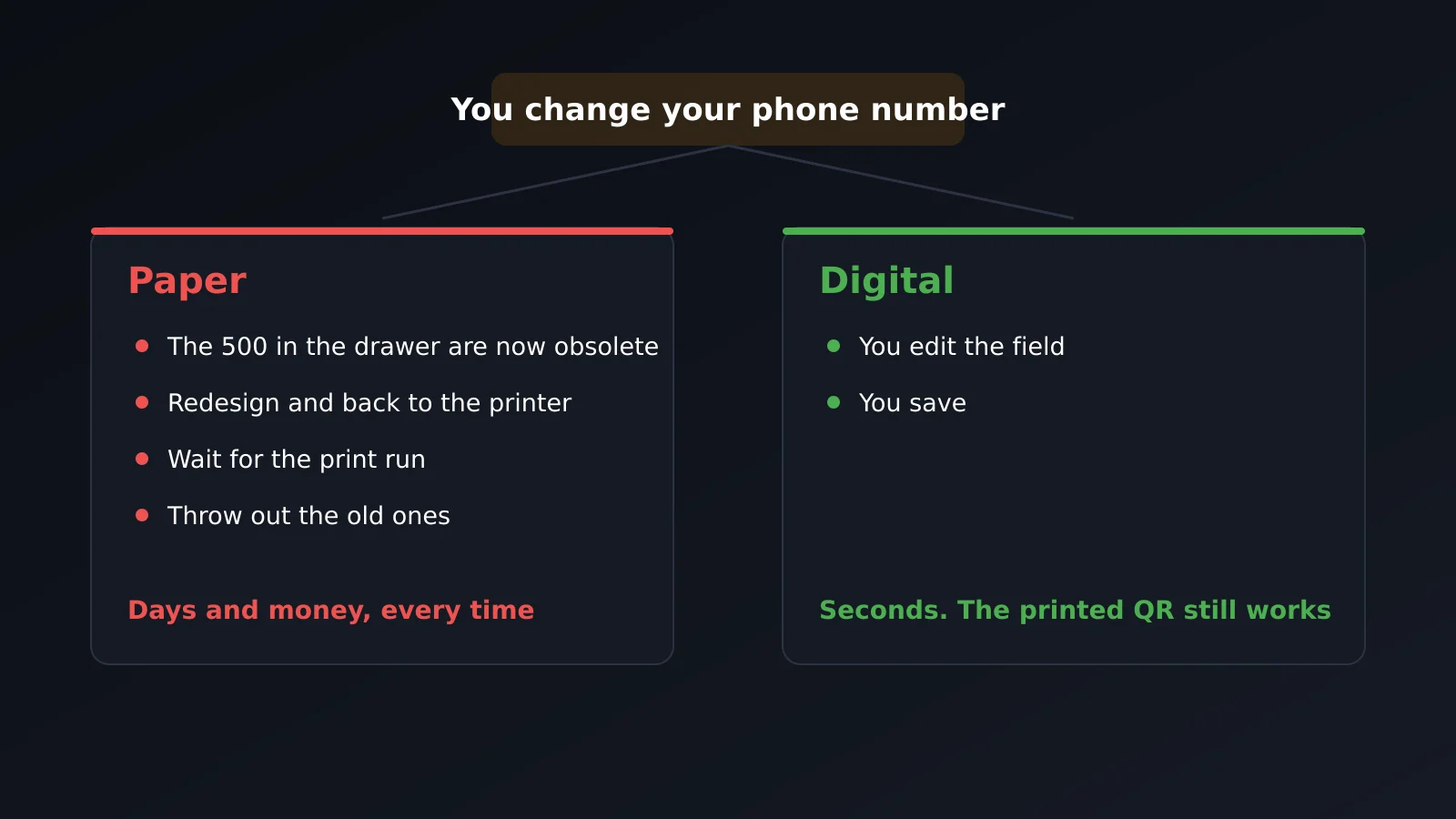
A print run of paper cards has a fixed cost you pay in full every time something changes. If you ordered 500 units and six months later you change your phone, your job title, or your email address, those 500 cards go in the trash and you repeat the entire order, even though only one line changed.
A digital card doesn't have that problem because the content lives in a profile you edit, not in a printed object. You change your phone once and every QR you've already distributed, every NFC tag you've already handed out, and every link you've already emailed automatically point to the new information.
An example, not a market figure
If your last print run cost you, for example, between 40 and 80 € for 250–500 cards — the typical range from a local printer — that expense repeats in full every time something changes. CardQR's free plan lets you create and share cards at no cost, and the Pro plan, with contact capture and analytics, costs $2.99/month or $29.90/year: less than a single reprint, and without needing a second one.
Paper leaves no trace; digital does
You hand out fifty paper cards at an event and there's no way to know how many were read, how many were saved, or how many ended up in a trash can at the end of the day. The card did its job the moment it changed hands, and that's where all the information you'll have about it ends.
A digital card logs every visit: when it was opened, from which country, from what type of device, and whether it ended up in a saved contact. It's not a difference in convenience: it's the difference between believing an event went well and having the numbers to know it.
Who captures whose data
The paper card is a one-way channel: you give your data and wait. The other person keeps the cardboard or loses it, but at no point have they given you anything in return.
A digital card can carry a capture form right on the public page, so whoever views it can also leave their contact if they want to keep talking. That's the real change: the card stops being just a presentation and becomes a tool that works in both directions.
A rectangle of 85×55 mm has physical limits
A paper card can't fit a video, a PDF with your catalog, or a button to book a meeting on your calendar. It fits the name, the job title, a phone number, and maybe a tiny QR code in a corner.
A web page has no such limit. Widgets (links, booking calendar, video, PDF download) turn the card into the start of a conversation, not the end of a handoff.
Sustainability, without figures I can't verify
A paper card that gets thrown away because the information has expired is an object that was manufactured, printed, and transported only to end up in the trash after a few months. I won't put a figure on tons of paper saved because I haven't verified it, but the basic fact is simple: a digital profile that you edit doesn't generate that waste every time information changes.
When paper still wins
There are contexts where the physical card still makes sense, and saying otherwise is just hot air:
- Very traditional sectors, where handing over something tangible is part of how things are done.
- Countries where exchanging cards is a social ritual with its own rules — Japan is the most cited example — and skipping it is noticeable.
- Meetings where pulling out your phone breaks the mood, for example a formal business dinner.
- The other person has no battery or signal, something that still happens and a physical object solves without depending on anything.
The answer that works in practice is almost never "digital only" or "paper only": it's a physical card with a printed QR code or NFC chip inside, which fulfills the social ritual and the gesture of handing something over, and which also leads to a profile that updates and logs who viewed it. We explain this in more detail in QR or NFC: which to use in each situation.
| Paper | Digital | |
|---|---|---|
| Correcting information | Entire print run in the trash | Edit the profile, instantly |
| You know if it was used | No, no trace | Views, country, device, saved contacts |
| Direction of exchange | You only give your data | Can capture data from whoever views it |
| Capacity | Name, job title, phone | Video, PDF, calendar, links |
| Cost when something changes | Full print run repeats | No additional cost |
| Social ritual / no phone | Always wins | Depends on battery and signal |
Frequently Asked Questions
Does the digital card completely replace paper?
In most business contexts, yes, and with an advantage: it corrects without cost and leaves a trace of every contact. In contexts where the physical object matters in itself, the reasonable thing is to carry a physical card with a QR code or NFC chip inside, which does both things at once.
How much does it cost to maintain a digital card versus reprinting paper?
It depends on the provider, but as a reference: CardQR's free plan has no cost, and the Pro plan costs $2.99 a month or $29.90 a year. If your last paper print run cost, for example, 40–80 € for a few hundred units, that expense repeats in full every time something changes — the digital plan doesn't.
Can you capture the other person's data with a paper card?
Not automatically. At best, you can ask them to give you their card in return. A digital card can carry a capture form directly on the public page.
What if the other person has no battery or doesn't want to pull out their phone?
That's where paper wins. It's exactly why many companies still carry a physical card, even if it has a QR code or NFC chip printed inside.
Is a digital card more sustainable?
It generates less waste every time information changes, because there's no need to reprint or throw anything away. There's no reliable figure for how much paper is saved overall, but the basic mechanism — avoiding a new print run for each change — is real.
In summary
The digital card wins on cost from the second change, on traceability from day one, and on capacity because it's not limited to a rectangle. Paper still wins when the ritual of handing something over matters as much as the data, or when the other person can't or doesn't want to pull out their phone. The solution that works almost always is to have both things in the same object: a physical card with a QR code or NFC chip that leads to a digital profile. You can read what exactly that profile is in what is a digital business card, and compare plans on the pricing page.
Create your card for free and test it with your next phone change.